IT & Server Room
Relocation in Dubai
Cable Documentation, ESD-Safe Transport, and Verified Systems Before Sign-Off Across Dubai and the UAE
Every Dubai office move has an IT problem waiting to happen. Not usually damaged servers — the reconnection. Unlabeled cables at the patch panel. A rack configuration nobody photographed. A SAN that won't initialise because the fibre channels went back in the wrong sequence.
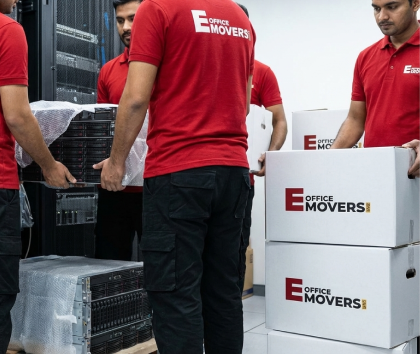
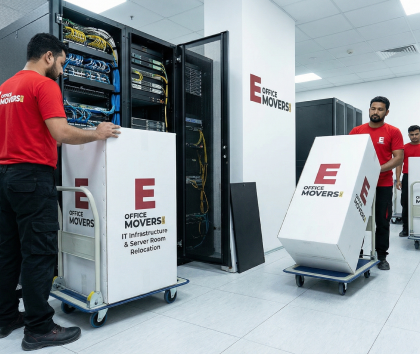
eOfficeMover UAE handles IT and server room relocation as a two-layer operation — physical logistics and documentation. Cable map before disconnection. ESD-safe packing. Climate-controlled transport. Verified systems before sign-off.
Request an IT Relocation Survey — Free & No Obligation
Available Sunday to Thursday, 8AM–7PM. Friday by arrangement.
Call NowSend your office address, workstation count, and move date for a fast response.
WhatsApp UsFor RFQs, IT scope documents, and detailed project briefs.
Send EmailThe Survey is Free. The Quote is Binding.
No phone estimates. Everything that follows the survey is based on what was seen at both sites.
Request an IT Relocation Survey
We'll confirm a survey date within one business day.
What types of IT and infrastructure moves does eOfficeMover UAE handle?
01
Workstation and desktop IT relocation
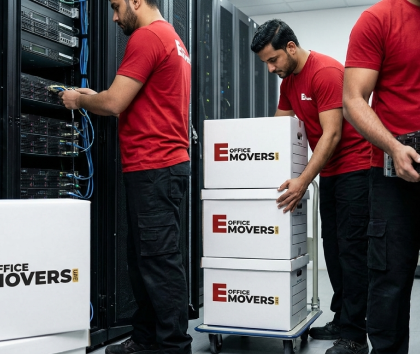
Computers, monitors, keyboards, VoIP desk phones, docking stations, UPS units, and associated accessories across all workstations in the office. Each workstation travels as a labeled set — monitor, CPU, peripherals, and cables together — so reinstallation at the new location assigns each employee's exact setup to their assigned desk position.
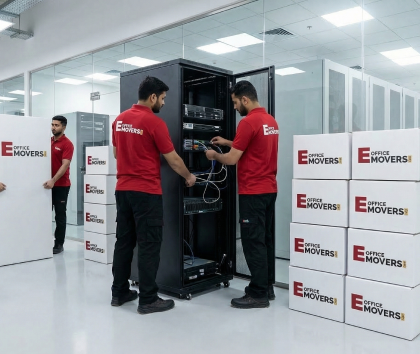
Server room migration
The most technically demanding part of any office move. Server rooms contain equipment where incorrect reconnection isn't just an inconvenience — it can cause data corruption, RAID array failure, and service outages that take days rather than hours to resolve.
02
03
Network infrastructure relocation
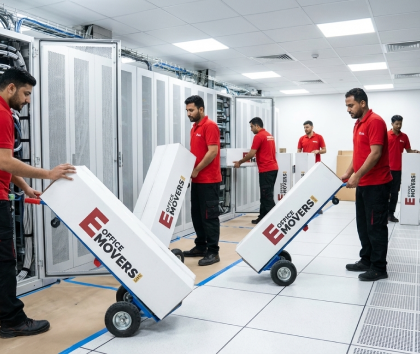
Switches, routers, firewalls, patch panels, fibre channel connections, and structured cabling equipment. Network infrastructure is the layer that everything else depends on — a switch reinstalled in the wrong rack position or a fibre channel connected to the wrong port takes the entire network down while it's debugged.
UPS (Uninterruptible Power Supply) systems
UPS units are heavy, contain large battery arrays, and require specific handling. Standard UPS batteries are sealed lead-acid and can be transported. But UPS units with swollen, damaged, or end-of-life batteries require separate handling and cannot be loaded alongside other equipment — damaged lead-acid batteries present a hazard during transport.
04
05
AV and conferencing infrastructure relocation
Video conferencing systems, smart boards, digital signage, projection systems, ceiling-mounted AV equipment, and conference room integrated controls. These systems involve ceiling or wall mounting, structured cabling to AV controllers, and configuration that must be documented before disassembly.
Telecoms and PABX relocation
PABX systems, telephone exchanges, VoIP gateways, and associated wiring infrastructure. PABX configurations require documentation of extension mapping, trunk lines, and trunk group assignments before the system is powered down.
06
What makes IT relocation different from general office moving?
Three specific risks that standard moving approaches don't address.
Electrostatic
Discharge
ESD — electrostatic discharge
Static electricity is invisible, unfelt, and can permanently damage electronic components without any outward sign of the damage. A server motherboard that was exposed to an electrostatic discharge event during packing may still power on and appear to function normally — and then fail in the weeks after the move as the latent damage develops.
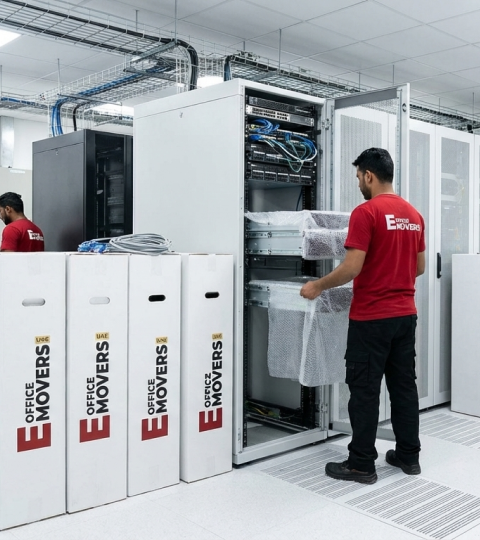
ESD-safe materials are not optional for IT relocation. Every server, every network card, every storage device, every component removed from a rack travels in anti-static packaging — anti-static bubble wrap, anti-static bags, and foam inserts that prevent the buildup and discharge of static electricity.
Items are handled with ground straps where appropriate. This is standard practice on every eOfficeMover UAE IT migration, not a premium add-on.
Temperatures
in Transport
UAE summer temperatures in transport
A standard moving truck with a closed cargo area in UAE summer reaches 50°C or above when parked or in slow traffic. Hard drives and solid-state storage devices have manufacturer-specified operating and non-operating temperature ranges — most non-operating maximums are in the 60 to 70°C range, but extended exposure to 50°C+ in an unventilated cargo area creates thermal stress that shortens component life and can cause immediate failure in sensitive equipment.
IT equipment travels in a climate-controlled vehicle in which the cargo temperature is maintained at an appropriate level throughout transit. This applies from May through October as standard, and for particularly sensitive equipment (high-density storage arrays, blade servers) year-round.
and Shock
on UAE Roads
Vibration and shock on UAE roads
UAE roads are generally good, but they include speed bumps, lane merges, and road surface transitions that create sudden shock inputs. Hard drives — particularly spinning-disk drives in older servers and NAS arrays — are sensitive to vibration and shock. A drive that was in a degraded RAID state before the move may fail completely from the physical shock of a speed bump at the wrong moment.
Server racks and rack-mounted equipment travel either intact (rack-stay, with equipment secured within the rack and the rack secured within the vehicle) or de-racked (equipment individually packed and shipped separately). The rack-stay vs de-rack decision depends on the distance, road route, and equipment type — not on what's more convenient for the loading crew.
This decision is made at the survey, not improvised at loading.
What does a full IT relocation service include?
Seven integrated components — from infrastructure audit through to post-move systems verification.
Pre-move IT infrastructure audit
The IT environment at the origin is assessed before any move plan is finalised. The audit covers:
- Complete asset inventory — every server, switch, router, firewall, UPS, patch panel, AV system, and peripheral
- Rack configuration documentation — what equipment is in which rack, in which unit position
- Network dependency mapping — which systems depend on which other systems, in what order they must be powered down and restored
- Cable census — how many cables, what types (Cat6, fibre, coax, power), approximate volumes
- UPS battery condition assessment
- Any equipment that requires de-commissioning rather than relocation (end-of-life, damaged, or superseded hardware)
- Access and clearance conditions at origin and destination server rooms (door widths, floor loading, cooling infrastructure)
This audit informs the cable documentation session, the packing materials order, the vehicle specification, and the destination re-racking sequence.
Cable documentation — the session that makes reconnection reliable
This is the stage that separates a professional IT migration from a move where the IT team spends Sunday debugging.
Before any cable is disconnected:
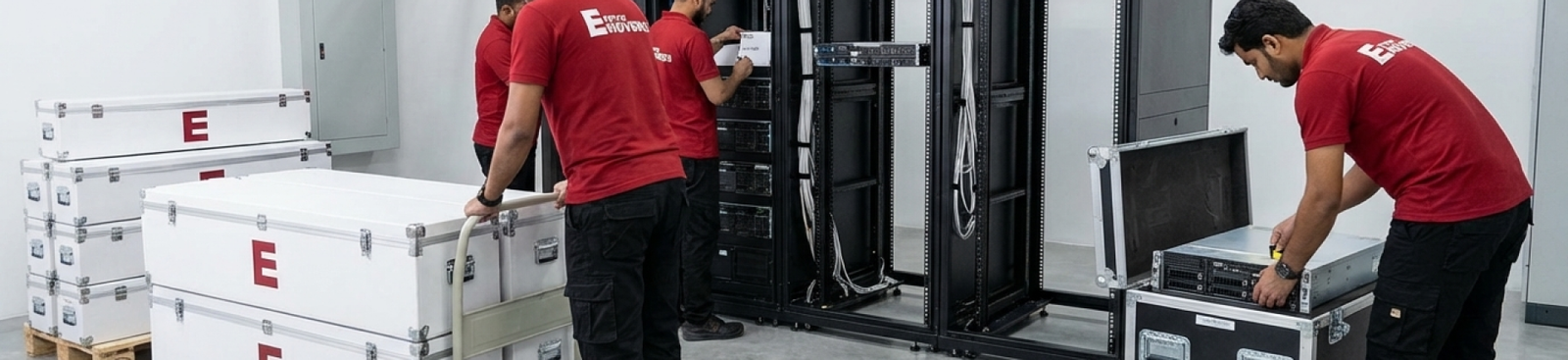
- Every cable at every connection point — servers, switches, patch panels, routers, firewalls, storage arrays, and workstations — is photographed at both ends
- Each cable is labeled with a unique alphanumeric reference number at both ends
- Patch panel port assignments are photographed and recorded in a matrix
- Rack unit positions for each piece of equipment are photographed and mapped
A cable reference map is produced: a document showing which cable number connects which device port to which destination port, at which rack position.
This map is what the IT team uses at the destination to reconnect the infrastructure. The difference in reconnection time is significant. A 30-workstation office with a standard server room has several hundred individual cable connections.
Reconnection takes under two hours. Every connection verified against documentation.
Reconnecting from memory takes most of a day — and carries the risk of incorrect connections that only show up under production load.
Data backup — responsibility and timing
Data backup before an IT migration is the responsibility of the client's IT team or managed service provider — not the physical relocation company. eOfficeMover UAE does not perform data backup operations.
What we do: we do not allow physical packing of any server or storage device to begin until the client's IT team has confirmed in writing that all critical data backups are complete and verified. This confirmation is documented in the move file. If the IT team has not confirmed backup completion, the packing sequence for servers and storage does not start.
This is the correct division of responsibility. The people who know the data architecture, the backup systems, and the recovery procedures are the client's IT team. The people who know how to physically migrate the hardware safely are us. Both responsibilities must be fulfilled before the equipment moves.
ESD-safe packing — by equipment type
- Anti-static bubble wrap for individual units where de-racked
- Anti-static foam inserts for blade servers
- Custom foam-lined crates for high-density equipment
- Drive trays wrapped individually in anti-static bags before the server chassis is wrapped
- Anti-static bubble wrap and sealed anti-static bags
- Equipment stacked with foam separators in climate-appropriate cartons
- Individual anti-static bags for drive trays where accessible
- Array chassis wrapped in anti-static material
- Custom crating for high-value enterprise storage
- Standard units with confirmed healthy batteries transported upright in reinforced cartons
- Units with damaged batteries handled under separate protocol
- Anti-static bags for open-frame components
- Original manufacturer packaging used where available
- Foam-padded cartons otherwise
- Corner-protected foam packaging
- Stacked face-to-face with interleaving foam
- Not loaded under other cartons
- Bagged and labeled with the corresponding workstation reference
- Stays physically with the workstation set throughout transport
Climate-controlled transport
IT equipment travels in a vehicle where the cargo temperature is controlled and monitored. In UAE summer conditions, this is not optional — it's the physical requirement for transporting equipment whose manufacturer specifications include non-operating temperature limits that a standard closed truck can exceed.
Vehicle specification is determined at the survey based on the volume and type of equipment. Fragile, high-value equipment (blade servers, enterprise storage, high-end network hardware) may travel in a separate climate-controlled consignment from general office furniture.
Destination re-racking and reconnection
At the destination server room, reinstallation follows the documented sequence from the pre-move audit. Equipment goes back into racks in the correct unit positions. Re-racking sequence follows the network dependency map — equipment that other systems depend on is racked and powered first.
Cable reconnection uses the cable reference map. Every cable is connected as documented. Patch panel assignments are verified against the pre-move photography. No connection is made from memory or assumption.
Post-move systems verification
Before the IT relocation team signs off, the following verification steps are completed:
If any system fails verification, the issue is identified and addressed before sign-off. The move is not complete until the systems pass verification.
How does the IT relocation process work?
Step 1
IT Infrastructure Audit
Both server rooms are assessed for asset inventory, rack configuration, cable census, and UPS battery condition. We review the network dependency map with your IT team to identify critical paths.
Step 2
Technical Move Plan
A written plan covering the cable documentation schedule, ESD-safe packing lists, rack-stay vs. de-rack decisions, and the re-racking sequence. This is aligned with your overall office move window.
Step 3
Backup Confirmation
The client IT team confirms and documents that all backups are complete and verified. This critical safety gate must be cleared and documented before any packing begins.
Step 4
Cable Documentation
Photography and labeling of every cable at every connection point. A comprehensive cable reference map is produced and shared with the client IT team for transparency.
Step 5
Controlled Shutdown
Your IT team manages the shutdown sequence in dependency order. Our team is on-site to begin packing immediately as each system is safely powered down.
Step 6
ESD-Safe Packing
Equipment is packed using anti-static materials specified in the move plan. Each item is labeled with its specific rack position reference to ensure an identical rebuild.
Step 7
Controlled Transport
Loading follows a reverse-unloading sequence in climate-controlled vehicles. GPS tracking is active throughout the journey to the destination premises.
Step 8
Destination Re-Racking
Unloading and racking follows the documented dependency order: critical network infrastructure first, followed by servers, then user workstations.
Step 9
Cable Reconnection
Every single cable is reconnected using the reference map produced in Step 4. We never rely on memory or assumptions for technical connectivity.
Step 10 — Systems Verification. Fully Operational.
Network, server, storage, and VoIP verification is completed. Sign-off only occurs once a representative sample confirms a verified working environment.
Book IT Relocation AuditWhat IT equipment does eOfficeMover UAE handle?
All standard corporate IT infrastructure — and a clear position on equipment that requires individual assessment before a move plan is confirmed.
Rack-mounted servers
1U, 2U, 4U, blade chassis
NAS and SAN
Network-attached storage and storage area networks
Routers, firewalls and switches
Core and access-layer switches
Patch panels and structured cabling
Full cabling infrastructure
UPS systems
Standard lead-acid battery units
PABX and VoIP telephony
Phone systems and handsets
Desktop workstations
All-in-one PCs, laptop docking stations
Monitors and display screens
All sizes and form factors
Peripherals
Keyboards, mice, VoIP desk phones, webcams, headsets
Printers and multifunction devices
Including scanners
Video conferencing systems
Cisco, Poly, Logitech, and others
Smart boards and interactive displays
All major brands
Projectors
Ceiling-mounted and portable
Digital signage
Controllers and displays
KVM switches
And console access equipment
How much does IT relocation cost in the UAE?
IT relocation costs depend on the volume and complexity of the infrastructure, not on the number of rooms or floor area. These are indicative starting ranges — the accurate quote follows a detailed IT infrastructure audit.
Includes cable documentation, ESD-safe packing, and climate-controlled transport (no dedicated server room).
Covers 1–2 server racks, rack density, storage complexity, and network infrastructure volume.
Based on rack count, equipment density, dependency complexity, and verification scope.
Key IT Cost Drivers
Technical relocation requires precise auditing. The IT infrastructure survey is free. The quote from the survey is binding.
Book IT Infrastructure AuditWhy choose eOfficeMover UAE for IT relocation?
It happens before anything is disconnected, every time. The cable reference map is produced before the first server is powered down. Reconnection at the destination uses the map — not memory.
Anti-static packaging for every piece of electronic equipment, from servers to desk phones. This is a standard safety requirement for us, not a premium add-on.
We don't use standard moving trucks for hardware. We provide a controlled environment for equipment to ensure the UAE summer heat never breaches manufacturer specifications.
Our technical audit includes a battery health check. Damaged or leaking batteries are identified early and never loaded alongside sensitive equipment on move day.
The move isn't complete when the last cable is plugged in. It’s done when the network is live, storage arrays are verified, and connectivity is confirmed across workstations.
Roles for both the client IT team and eOfficeMover UAE are documented in the move plan. No one discovers on Saturday night that they missed a critical task.
Frequently Asked Questions
IT & Server Room Relocation UAE
ESD (electrostatic discharge) is the sudden transfer of static electricity between two objects. For electronic components, a discharge that a person doesn't even feel can permanently damage a server motherboard or storage controller—sometimes as a latent failure that develops weeks later. Anti-static packing materials prevent static build-up during transport. This is why ESD-safe packaging is mandatory for IT equipment moves, not a premium option.
Data backup is the responsibility of the client's IT team or managed service provider. eOfficeMover UAE does not perform data backup operations. We require written confirmation from the client's IT team that all critical data backups are complete and verified before packing of any server or storage device begins. Packing doesn't start until this confirmation is documented and received.
This depends on distance, road conditions, and equipment type. For short moves on smooth roads, rack-stay can be appropriate for standard servers. For longer distances, routes with speed bumps, or sensitive storage arrays, de-racking and individual packing is the safer approach. This decision is made during the IT infrastructure audit—not improvised on loading day.
The issue is identified and addressed before sign-off. Common issues like cabling mismatches are resolved from the reference map, while software services or IP updates are handled by the client's IT team. The verification stage exists specifically to catch these issues while the move team is still on-site, ensuring you are fully operational by Sunday morning.
A small office (15 workstations) typically takes 3 to 5 hours. A medium server room (2 racks, 30 workstations) usually takes 8 to 12 hours. Large migrations may run across multiple sessions. Cable documentation is performed the day before the move to streamline the process. All timelines are confirmed in the written move plan after your IT audit.
Yes—and this is preferred. Documentation is most effective when your IT team confirms accuracy and flags non-standard configurations. Post-move verification is also more efficient when your team runs application-level tests alongside our connectivity checks. The move plan defines each party's role so both teams are coordinated from the start.
Yes. Video conferencing systems, smart boards, digital signage, and conference room integrated controls are included. Ceiling-mounted systems require specific lifting equipment and surface protection, which we assess during the survey. All AV configurations are fully documented before disassembly.
Yes. We handle IT and server room relocations across Dubai, Abu Dhabi, Sharjah, Ajman, Ras Al Khaimah, Fujairah, and Umm Al Quwain, including all free zones. Cross-emirate moves follow the same rigorous ESD-safe packing and climate-controlled transport standards as same-city migrations.
Have a technical question not listed here? Book a free IT infrastructure survey — our experts will review your server room and networking scope in detail.
Book IT Survey